What is the best way to take Omega 3? How to easily make it part of your daily routine

How well omega-3 is absorbed depends on how and when you take it (and, of course, on the quality of the oil). Many people wonder whether omega-3 should be taken with a meal, what the best time of day is, and whether capsules differ from liquid oil.
In this article, you can read about how to take omega-3 in a practical, effective, and simple way, tailored to your daily routine.
What is omega-3 used for?
Omega 3 is a collective term for several polyunsaturated fatty acids that the body cannot produce itself, including EPA and DHA. These fatty acids occur naturally mainly in oily fish. People who eat little or no oily fish may therefore benefit from an omega-3 supplement.
Omega-3 fatty acids play a role in various processes in the body:
- DHA helps maintain sharp vision and is an important building block for the brain.
- EPA and DHA are good for the heart and support normal blood pressure and normal blood triglyceride levels.
Why it is important to take omega-3 with a meal
Omega-3 consists of fatty acids and is absorbed most efficiently when taken with a meal that contains fat. If omega-3 is taken on an empty stomach, absorption may be less efficient and some people may experience mild stomach or intestinal discomfort.
Are you eating something small? Then it is wise to wait until a larger meal, so that your body can absorb the fats as well as possible.
When to take Omega 3: morning or evening?
There is no "best" time to take omega-3. Morning, afternoon, and evening are all suitable, as long as it is taken with or after a meal.
Some people like to take omega-3 at breakfast or lunch, while others prefer to take it with dinner. The most important thing is to choose a time that fits in well with your daily routine, so that you can continue to use it consistently.
How flexible is omega-3 in use?
Many people take omega-3 at a fixed time every day, which is a great way to fit it into their routine. But the good news is that omega-3 does not necessarily have to be taken at exactly the same time every day to be effective. If you forget to take it with you, for example on a weekend trip, you can simply take an extra large spoonful when you get home.
Omega-3 consists of fatty acids that are easily absorbed by the body and can then be stored. This allows the body to use these fatty acids when needed. In practice, this means that regular intake over time is more important than the exact moment or day.
Would you rather not take a supplement every day? Then a less frequent intake, such as a higher dose several times a week, may suit your lifestyle better. For example, many people opt for a daily intake because it is easy to remember, while others prefer to take it a few times a week. Both approaches are fine, as long as the total intake over time is sufficient.
When will you notice the effect?
It is important to note that regular intake does not mean that the effects of omega-3 are immediately noticeable. Although EPA and DHA are well absorbed after ingestion, these fatty acids gradually build up in the cell membranes of all your body's cells. This process takes time, which means that any noticeable effects usually only become apparent after several weeks or months.
How quickly this happens depends, among other things, on the intake, the desired effect, and the baseline omega-3 status, which can be determined with an Omega-3 index test.
Omega-3 capsules or liquid oil: which is the best choice?
Whether it is better to take capsules or liquid oil depends mainly on what you prefer for daily use. Both forms contain the same omega-3 fatty acids and are of equal quality. The choice is therefore not about what works better, but about what is most practical for you or your family.
- Capsules are tasteless, easy to carry, and provide exactly the same dosage every day.
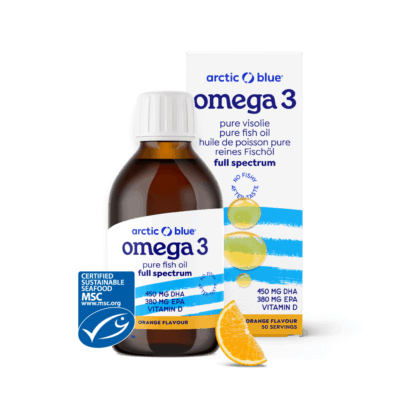
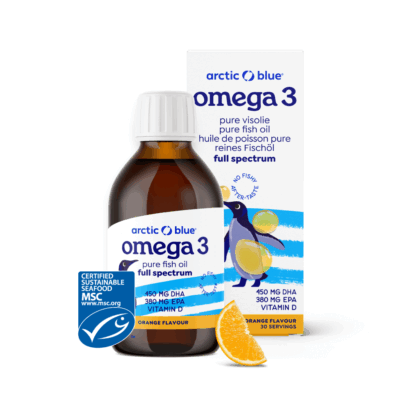
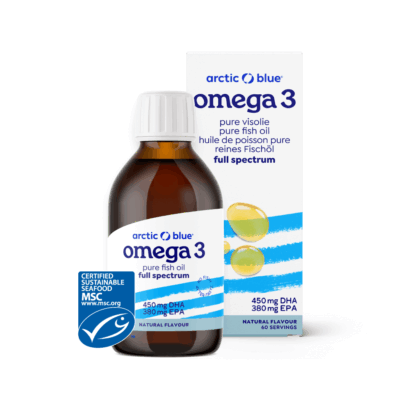
- Liquid oil is ideal for those who do not want to or cannot swallow capsules, for children, or for people who prefer to add the oil to their smoothie or yogurt.
Important to know: some people believe that liquid oil is fresher than oil in capsules. Although this is sometimes claimed by brands that do not offer capsules, the production process for capsules does not actually adversely affect the quality. That is not true. The quality is determined by the oil itself, not by the form in which you take it. Good producers fill capsules and bottles with exactly the same fresh oil.
Would you like help finding the Omega 3 supplements you need? Then take a look at the product selector.
Tips from the Arctic Blue team
We have tried various ways of easily adding fish oil and algae oil to our diet. We find the following methods convenient:
- mix with yogurt or cottage cheese
- add to a smoothie
- stirring warm or cold porridge or oatmeal
- by mixing cottage cheese
- add to a fresh salad
Do you prefer capsules? Simply take them with water during or after a meal.
What does this mean for you?
Omega 3 is a supplement that easily adapts to your lifestyle. Whether you take it daily or dose it more flexibly, the most important thing is to choose a method that you can stick to.
Have you taken a break, for example during vacation? No problem. You can simply resume taking it afterwards. And if necessary, take a double dose for a week.
The most important thing to remember: take omega-3 preferably with or after a meal that contains fat. This ensures the best absorption and the most comfort.
PS. Arctic Blue oil or capsules will never cause burping after ingestion. We call this the 100% no-burping guarantee. We can guarantee this because we always work with fresh (i.e., non-oxidized) fish oil or algae oil.